 EN


Frequently asked questions
Hands-Free Highway Assist is intended for suitable motorways and may allow the driver to take their hands off the steering wheel only under specific conditions. The limit specified for Germany is 130 km/h, while the US market limit is 85 mph, approximately 137 km/h.
MB.DRIVE ASSIST PRO helps follow an urban route, change lanes, turn, stop at traffic lights and pull away again. The driver must continuously monitor the drive, and in the Car and Driver test the journalist had to keep a hand on the steering wheel.
In Germany, the highway assistant with hands-free driving and automatic lane changes is scheduled for late 2026, while MB.DRIVE ASSIST PRO is planned for the first half of 2027. In the United States, early access will begin in December 2026 for selected customers in California; wider deployment and the commercial launch are planned for 2027.
Mercedes-Benz announced on November 16 that it is expanding the MB.DRIVE family of driver-assistance systems in Germany and the United States. On suitable motorways, Hands-Free Highway Assist will allow drivers to travel without holding the steering wheel, while MB.DRIVE ASSIST PRO will add support for urban routes, including turns, lane changes and stops at traffic lights.
The driver must continue watching the road and be ready to intervene at all times. The option to release the steering wheel applies to the highway mode under specific conditions. It cannot be treated as permission to drive hands-free throughout an entire city journey.
What the car will handle on the highway
Hands-Free Highway Assist helps keep the vehicle in its lane while allowing the driver to take their hands off the steering wheel. The Mercedes-Benz announcement for Germany specifies a limit of 130 km/h. For the US market, the manufacturer cites 85 mph — approximately 137 km/h — on suitable limited-access highways. DISTRONIC adaptive distance control must also be active.
The accompanying Proactive Lane Change Assist can initiate and complete a lane change on its own when road conditions allow. The manufacturer's examples include overtaking a slower vehicle and moving into the correct lane before an exit specified by the navigation route.
The system therefore covers lane keeping and some maneuvers between lanes. Availability depends on the road, traffic conditions and the vehicle's equipment: simply being on a motorway is not enough to activate the mode.
How MB.DRIVE ASSIST PRO will help in the city
MB.DRIVE ASSIST PRO extends assistance to routes beyond the motorway. When navigation guidance is active, the system is switched on using a steering-wheel button and helps the driver leave the highway, move into the required lane, turn at an intersection, brake at a traffic light and pull away again.
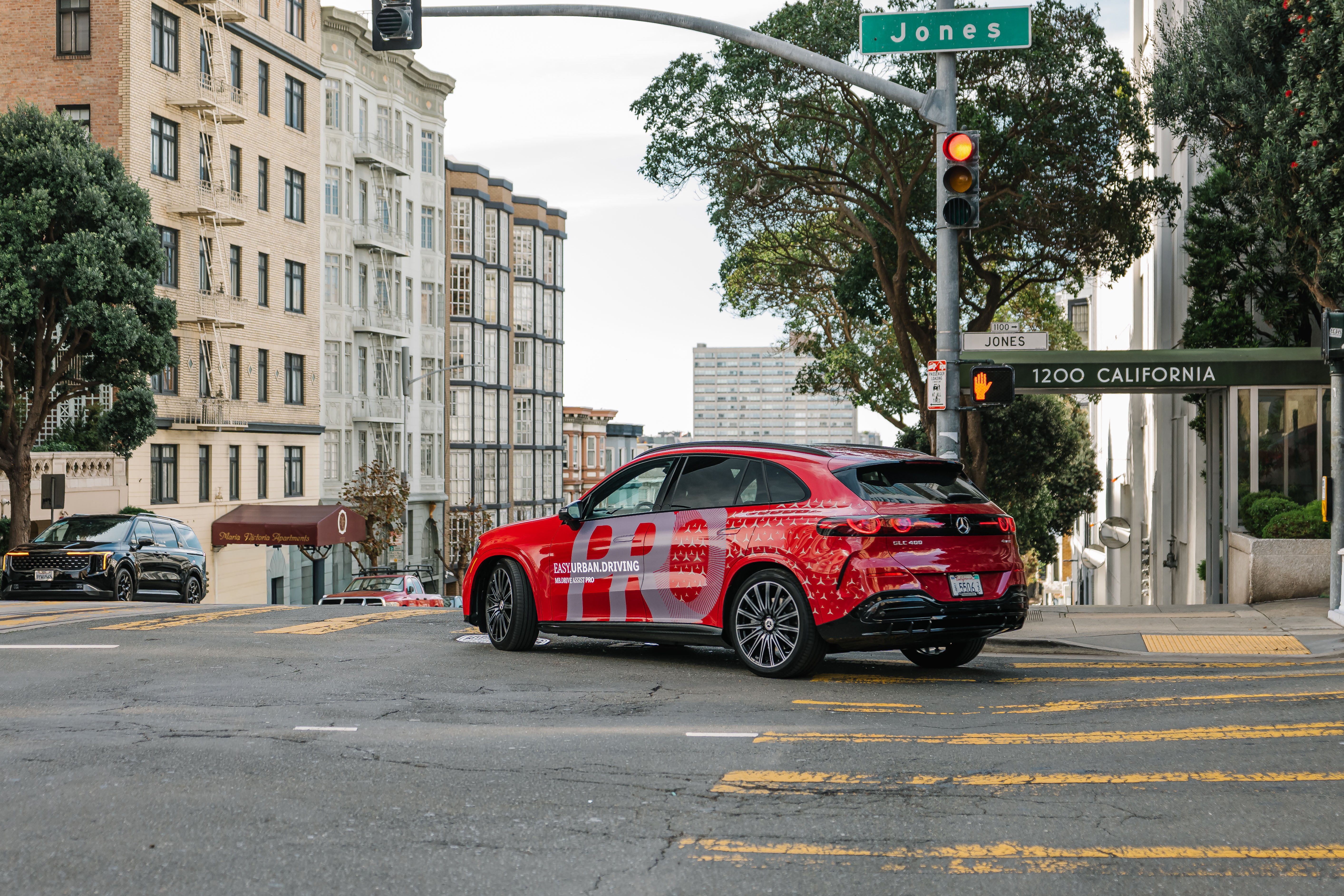
Its hardware includes 10 cameras, five radar sensors and 12 ultrasonic sensors. However, the sensor package alone does not mean the vehicle can complete any route without human involvement. In a Car and Driver test published on November 16, the journalist had to keep a hand on the steering wheel while the urban assistant was operating.
Route assistance and hands-free driving are different capabilities. When choosing a vehicle specification, it is worth checking which functions are available on that particular car.
Function | Where and how it helps | What remains the driver's responsibility |
|---|---|---|
Hands-Free Highway Assist | Maintains lane position on suitable motorways; allows the driver's hands to leave the steering wheel when the required conditions are met | Watch the road and intervene immediately when necessary |
Proactive Lane Change Assist | Initiates and completes lane changes, including for overtaking or following the navigation route | Monitor the surroundings and the execution of the maneuver |
MB.DRIVE ASSIST PRO | Helps follow a route, including through urban intersections and traffic lights | Continuously monitor the drive and observe requirements concerning hand position on the steering wheel |
Why taking your hands off the wheel does not mean looking away from the road
Mercedes-Benz classifies the new assistants as SAE Level 2, or partial automation. The system can control several vehicle functions at the same time, but the driver remains responsible for monitoring the road situation. In highway mode, an interior camera monitors the driver's attention and issues a warning when necessary.
The official Mercedes-Benz USA driver-assistance page separately explains how the system differs from DRIVE PILOT, which is classified as SAE Level 3 and operates under its own defined conditions. Buying MB.DRIVE ASSIST PRO does not give the vehicle DRIVE PILOT capabilities.
What journalists experienced on their first drives
Car and Driver and MotorTrend published impressions from drives in the San Francisco area on November 16. During the Car and Driver urban test, the vehicle was slow to move off after stopping at a red light when the signal turned green, reacting to people moving near the crosswalk. The journalist had to intervene by pressing the accelerator.
MotorTrend noted the urban assistant's smooth turns and lane changes, but also described delays at intersections. In highway mode, the publication found the system-status indicators insufficiently clear. These observations came from specific drives using the demonstrated software; they do not establish the error rate of the future production system as a whole.
When the functions will arrive in Germany and the United States
In Germany, the highway assistant with hands-free driving and automatic lane changes is scheduled for late 2026. For MB.DRIVE ASSIST PRO, the company specifies the first half of 2027. From December 2026, selected customers in Stuttgart and Munich are expected to receive early access to urban route assistance.
In the United States, an early-access program for both assistants will begin in December 2026 for selected customers in California. Wider deployment of Hands-Free Highway Assist is planned for spring 2027, while the commercial launch of MB.DRIVE ASSIST PRO is scheduled for 2027. The urban assistant may be subject to specific geographic restrictions at launch.
Invitation-only early access does not mean the function will be available to every owner of the model. Timing depends on the market and the vehicle; the announcement for Germany and the United States does not set a launch date for other countries.
Which vehicles may receive the update and what it will cost
The US early-access program is expected to select owners and customers leasing the 2026 and 2027 model-year CLA Electric Sedan, as well as the 2027 model-year GLC Electric SUV, S-Class Sedan, GLE SUV and Coupe, and GLS SUV. This list applies to the US program and should not be treated as a list of all compatible vehicles in every market.
The Mercedes-Benz US press release provides for purchasing MB.DRIVE ASSIST PRO through a digital store and receiving it through an over-the-air update on a compatible vehicle with the required equipment. The company mentions one-month, one-year and three-year subscriptions; the release does not disclose specific prices.
For someone buying a new or used Mercedes-Benz, this makes it worth checking more than just the package name in the listing. The model year, installed equipment, market availability and digital-function activation terms also matter. The presence of cameras or conventional adaptive cruise control does not by itself confirm that the vehicle can activate urban assistance or hands-free driving.